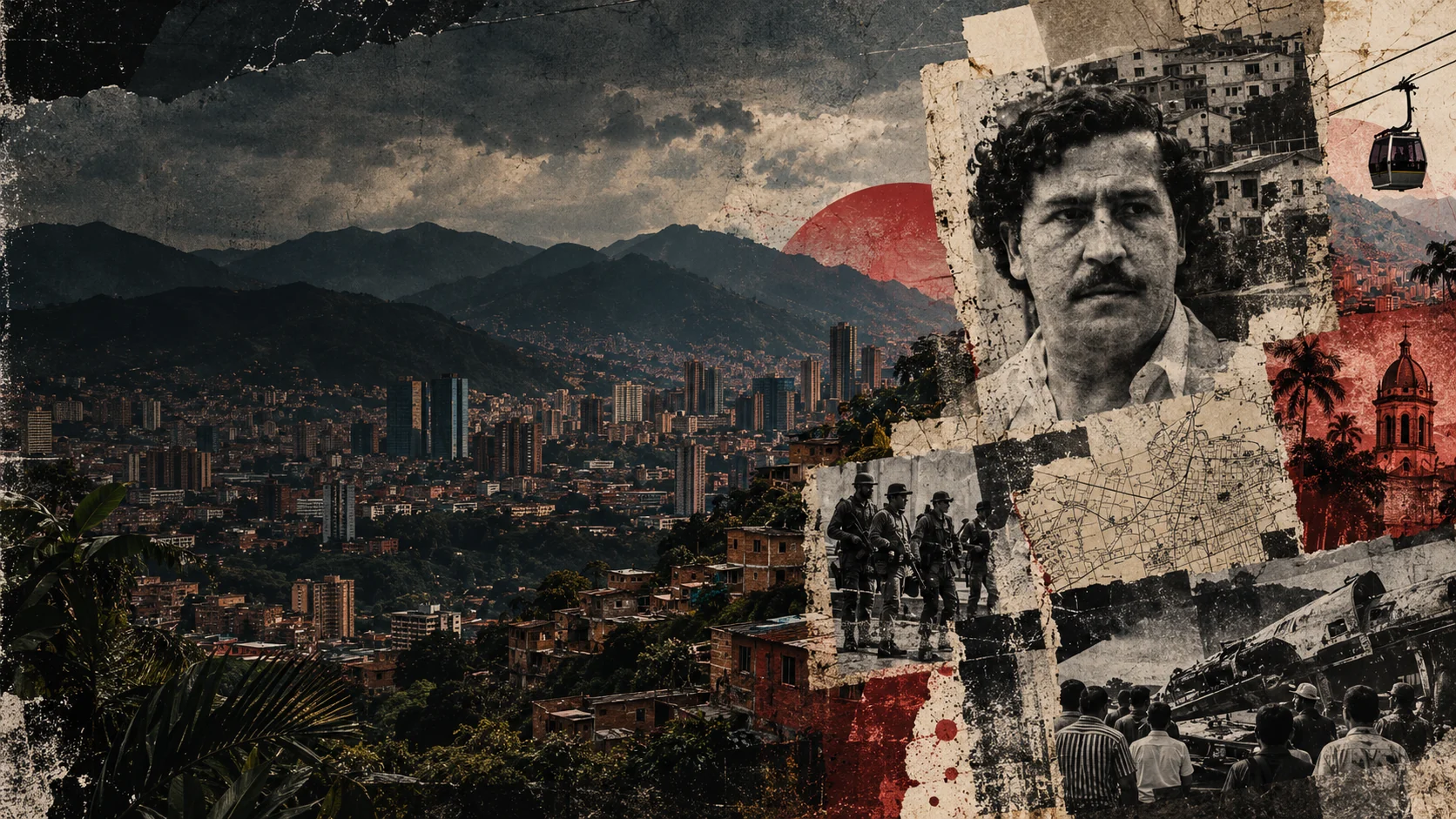
Start before the celebrity story
The drug-trafficking era did not appear from nowhere, and Medellín’s history cannot be explained by one man. A responsible tour should give you context about institutions, inequality, armed actors, state responses, victims and the broader Colombian conflict rather than jumping immediately to famous properties and death sites.
That does not mean every tour needs to become a university lecture. It means the story should have causes, consequences and people other than the traffickers themselves.
The 1980s and early 1990s are not entertainment scenery
Tourism often compresses violent periods into an efficient sequence of dates and photo stops. Remember that bombings, assassinations, kidnappings and neighborhood violence affected real families and institutions. The distance created by decades, television dramas and global pop culture can make the material feel fictional when you visit. It was not.
1993 is an endpoint, not the end of Medellín’s story
Many Pablo-focused tours naturally build toward 1993. A broader Medellín history tour should keep going. The city’s transformation, its public spaces, community organizing, transport projects, cultural institutions and ongoing inequalities are part of what a visitor is seeing today.
Medellín Travel itself frames memory and transformation together, including places such as Museo Casa de la Memoria, Comuna 13, Moravia and Parque de la Inflexión.
Use tour narration as a starting point
Guides vary in quality and perspective. Some grew up in the neighborhoods they discuss. Some focus on crime history. Some emphasize victims, urban change or political context. Listen, ask questions, and then verify specific claims that matter to you.
Be especially cautious with stories that are suspiciously cinematic, impossible to source, or built around a guide claiming secret personal access to famous figures.
A better question than “Was he good or bad?”
The useful questions are more concrete: Who benefited? Who was harmed? Why did some communities develop complicated relationships with traffickers? What did violence do to public life? How does a city remember people who were murdered while also acknowledging the social conditions that made criminal power possible?
Those questions produce a more interesting tour and a less cartoonish understanding of Medellín.
Spend time in Medellín outside the narco frame. Museums, food, parks, contemporary culture and community-led tours keep one violent period from becoming your entire picture of the city.
What should I do after the tour?
If you mainly want the biography and famous sites, a Pablo-focused tour is more direct. If you want to understand the city, institutions, victims and transformation, choose a broader history route or combine the two.
Should I take a Pablo tour or a broader Medellín history tour?
No. Difficult-history tourism can be thoughtful and educational. The framing, guide, behavior of the visitor and balance of the story matter.
Is taking a narco-history tour automatically disrespectful?
Quick FAQ
- Read the actual itinerary before booking.
- Look for attention to victims, memory and present-day Medellín.
- Avoid marketing that celebrates criminal wealth or violence.
- Respect photography rules at memorials, cemeteries and neighborhoods.
- Do not treat residents as characters in a crime story.
- Pair a perpetrator-focused tour with a memory or transformation experience.
A responsible-tour checklist
If you take a guided tour, listen for the transitions between stops. The quality of the experience is often revealed there. Does the guide explain why a place matters, what changed afterward and whose perspective is missing? Or does the route simply move from notorious name to notorious name?
Do not try to turn difficult history into a scavenger hunt. Pick a small number of places that add different kinds of context. A former property can explain power. A memorial can recenter victims. A neighborhood can show how memory lives alongside ordinary daily life. A museum can slow the pace and give you language for understanding what a fast commercial tour has compressed.
How to use this guide on the ground
Verify the details that can change
Tour logistics, operating days, access rules and inclusions can change. These sources are useful starting points for checking current information.